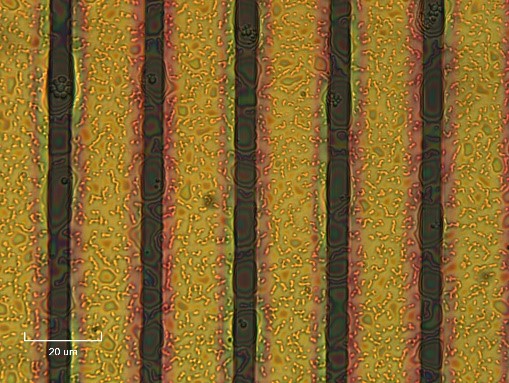
The Laboratory of Molecular and Device Physics is interested in understanding i) charge transport, ii) magneto- and spin transport, and iii) heat transport in novel (semi)conductor materials. To do so, we employ physical and physico-chemical characterization techniques to understand which materials are most suited for application in electronic, magnetic, and optical devices and sensors.
Hybrid Molecule/Quantum Material van der Waals Heterostructures
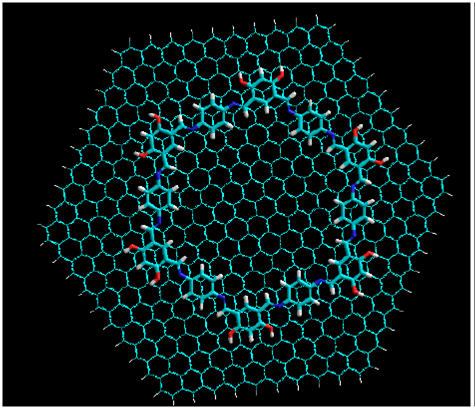
Part of our team focuses their efforts on studying the exotic and novel properties arising from artificial novel materials formed by hybrid structures formed by quasi-2D supramolecular networks assembled on Quantum Materials. These structures are called Hybrid van der Waal Heterostructures (H-vdWH). This research facility is aimed at shedding light on new electronic and optical phenomena in (i) molecular solids such as organic semiconductors and (ii) quantum materials such as graphene and transition metal dichalcogenides.
Relevant recent publications:
A Hybrid Molecule/Graphene van der Waals Heterostructure for DNA Immobilization and Detection Z. Yang, A. A Greschner, L. Skokan, A. Ruediger, O. Sedlacek, R. Hoogenboom, M.A. Gauthier, E. Orgiu Nano Letters 25 (22), 8884-8891 2025

Surface-Confined Macrocyclization via Dynamic Covalent Chemistry C. Fu, J. Miksatko, L. Assies, V. Vrkoslav, S. Orlandi, M. Kalbac, P. Kovaricek, X. Zeng, B. Zhou, L. Muccioli, D. F. Perepichka, E. Orgiu ACS nano 14 (3), 2956-2965 2020
Organic Semiconductors
Recent advances in fundamental understanding, coupled with the introduction of new materials and synthetic routes, have enabled the development of prototypical devices with new functionalities and the performance for some devices is now on par with established inorganic technologies. Our team focuses on understanding structure-property relationships in this class of materials. That includes macromolecular semiconductors, conjugated polymers, molecular dopants, self-assembling surface-modifying molecules, open-shell organic semiconductors, and two-dimensional organic conjugated networks.
EQUIPEMENT
To study magnetoresistance, charge carrier transport, and general thermoelectric phenomena in (semi)conductive systems, the Molecular and Device Physics Laboratory has a cryogenic system for the characterization of charge, spin, and heat transport devices (PPMS DynaCool).
This instrument enables the electronic characterization of devices subjected to a wide range of temperatures down to 1.8K and exposed to the effects of magnetic fields up to 9T. Measurements carried out under high vacuum (<10-4 Torr) with precise and progressive temperature control are fully automated and remotely accessible, making it possible to perform extended characterizations.
 Orgiu Research Group